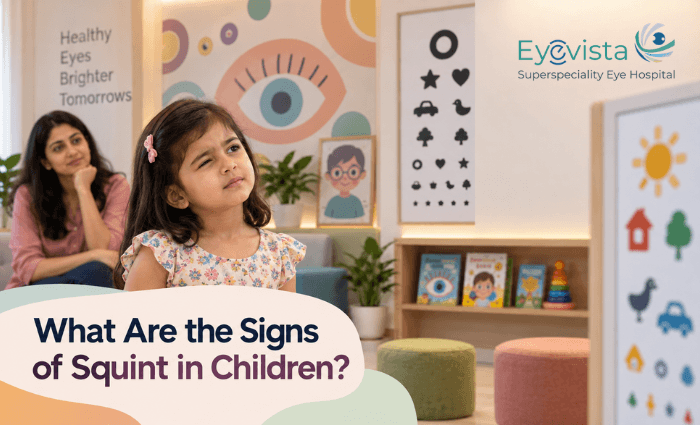
Learn the common signs of squint in children, including eye misalignment, unusual head positioning, and difficulty focusing. Early detection and treatment can help protect healthy vision development.
The eyes of a child should normally be aligned to focus on the same object. However, when the eyes move differently, the eye disorder is referred to as squinting or strabismus. It is important to know signs of squint in children to ensure that the visual development system is not affected in any way.
Squinting may be always present or may occur due to exhaustion, illness, or concentration on an object. There are children who have less visible symptoms.
What Is a Squint?
In squint, there is improper alignment of the eyes which do not focus on the same point. This means that one eye might move inward, outward, upward, or downward as the other eye moves forward normally.
The misalignment can either be continuous or intermittent. In most cases, one eye is affected more often than the other. Although a squint may be easily identifiable in some instances, there are cases where the signs become evident only in certain situations.
What Are the Signs of Squint in Children?
The following are some of the visual or behavioral signs that parents can recognize.
Some of the most common symptoms of squint in children are as follows:
- Turning one eye in, out, upwards or downwards
- Misalignment of the eyes while observing objects
- Frequent closure or shielding of one eye
- Turning the head in order to view something
- Narrowing of the eyes when viewing something
- Inability to judge distance
- Complaining of seeing double
- Frequently knocking into things
- Difficulty in concentrating on reading and close work
- Abnormal head posture when watching TV or viewing an object
It is possible that a child will not complain about poor sight since children can adjust to vision changes very effectively. Hence, the behavioral signs can sometimes be the initial indication.
What Are the Signs of Squint in Babies?
Parents usually question themselves if occasional eye wandering in their child is normal. In early childhood, misalignment may happen because of developing vision systems. But when eye wandering happens frequently, parents should take a baby to an ophthalmologist.
Signs of squint in babies include one eye pointing inward or outward, difficulty keeping alignment of both eyes, or constantly using only one eye.
In case there is no improvement in a baby's eye alignment, an ophthalmic check-up will tell about the necessity of any further treatment.
Why Does Squint Develop in Children?
Several causes of squint in children could exist. The child can have been born with squinting eyes or might have developed squinting at some point in time. Refractive errors, unequal vision in both the eyes, disorders related to eye muscles or nerves, and medical conditions can be among the reasons behind misalignment of the eyes.
Sometimes, it becomes difficult to know the actual reason behind squinting. An eye examination enables the expert to figure out the functioning of the eyes and the vision problems.
Can a Squint Affect a Child's Vision?
Certainly. The brain will get dissimilar images from each eye because the eyes do not focus in the right manner. This could be especially true for a young child where the brain starts to favor one eye over the other.
This can contribute to amblyopia, commonly called lazy eye, where vision in one eye does not develop normally. This is one reason early assessment of childhood squint symptoms is so important.
If there is squinting in a child, it can also cause problems in binocular vision, which helps in judging the relationships between objects.
When Should Parents Seek Medical Advice?
The need for the child to have his eyes examined arises if there is a problem such as the eye being misaligned or turning often, along with an odd way of looking at things.
This is even more urgent when there is a sudden onset of squinting, when it is accompanied by double vision, an injury to the head, or other strange signs.
Knowing when to see an eye specialist for a squint can make a meaningful difference because treatment is often more effective when vision problems are identified during childhood.
How Is Squint Treated in Children?
Squint treatment for children depends on the type and cause of the misalignment, the child's age and whether vision in either eye has been affected.
Possible treatment modalities can include spectacles to address refractive issues and patching to help a weaker eye work better. While some children may need certain types of exercises, others may be advised to undergo surgery to align their eye muscles.
Pediatric Ophthalmology & Squint Services at Eyevista Eye Hospital entails evaluating the child's eyes and determining the best way forward with respect to treatment.
Give Your Child's Vision the Right Attention
The signs of squint in children may sometimes be easy to overlook, particularly when a child has adapted to the way they see. If you notice an eye turning, unusual head positioning, frequent covering of one eye or other changes in your child's visual behaviour, an eye examination can provide valuable answers.
If you are concerned about your child's eye alignment or vision, schedule an appointment with Eyevista Eye Hospital. The pediatric eye-care team can assess your child's eyes and recommend appropriate care to support healthy visual development.
Experiencing Sudden Vision Changes or Eye Pain?
Symptoms like sudden curtain-like darkness, flashes of light, an explosion of floaters, or severe persistent eye pain warrant immediate attention.
Consult Dr. Ankit Shah at Eyevista
Get accurate diagnostic care with advanced ophthalmic technology at our Paldi clinic.

Dr. Ankit Shah
MBBS, DO, DNB, FICO (UK), Fellowship in Pediatric Ophthalmology & Strabismus
Dr. Ankit Shah is a renowned Pediatric Ophthalmologist and Squint Specialist at Eyevista Superspeciality Eye Hospital in Ahmedabad. With advanced fellowship training, he specializes in treating comple...
Clinical Conditions (Eyepedia)
Clinic Hours & Location
Monday – Saturday: 9:00 AM – 7:30 PM
Sunday: Closed (Emergency on call)
Paldi, Ahmedabad, Gujarat 380007