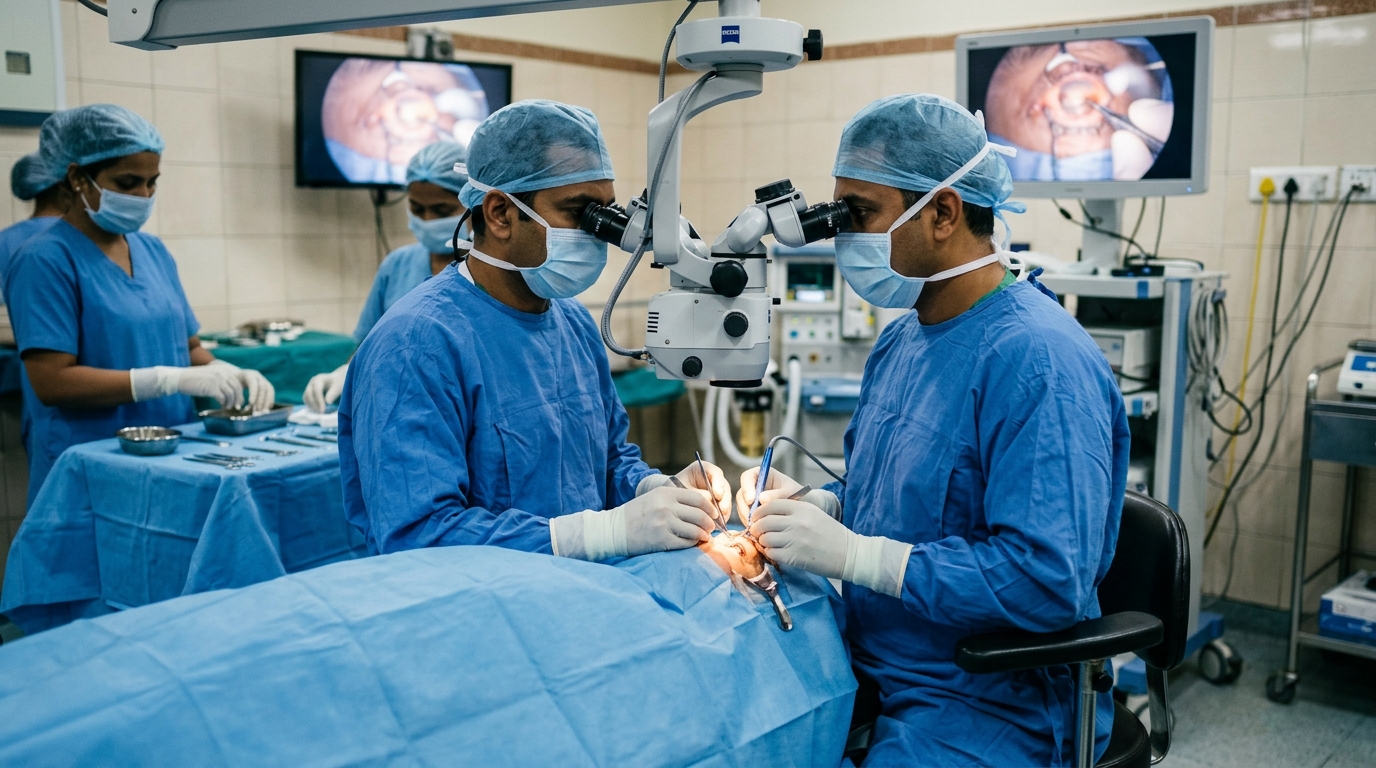
This article explains when corneal transplant surgery may be needed for conditions such as advanced keratoconus, corneal scarring, infections, and injuries. It covers the different types of corneal transplants, recovery expectations, and alternative treatments, while highlighting Eye Vista Hospital and its cornea specialists for personalised evaluation and care.
The cornea is a term that refers to the clear structure that covers the outer surface of the eye, aiding in focusing light rays. If the cornea gets injured or damaged, resulting in scarring, swelling, or any irregular shape of the cornea, no eyewear, drugs, or any other form of treatment will ever restore vision. In such cases, corneal transplant surgery can be opted for, replacing the dysfunctional part of the cornea with a new one.
When Is a Corneal Transplant Needed?
Well, now let’s take a look. When should a cornea transplant become necessary? Transplant surgery would normally only be advised by eye specialist doctors when the cornea is unable to be saved or helped by other means. An eye care specialist doctor may suggest that a transplant take place if the cornea becomes too cloudy, scarred, swollen, or damaged.
Reasons for corneal transplantation include advanced keratoconus, corneal infection or injury, some forms of corneal dystrophies, and scarring of the cornea. Keratoconus is a condition where the normal curves of the cornea weaken and thin. This allows the cornea to bulge and further irregularly steepen. The condition is progressive and can occur in one or both eyes. If conventional contact lenses are prescribed and do not alleviate symptoms, a corneal transplant may be required.
Can Keratoconus Require a Corneal Transplant?
Keratoconus patients who have a significant progression in their disease leading to corneal scarring can consider cornea transplantation. In addition, those who cannot cope with their contact lenses because of their condition can also undergo this treatment method. Nevertheless, not all patients with keratoconus require transplantation.
Traditional treatment methods such as specially designed contact lenses and corneal cross-linking are also possible treatments that can suit the needs of many patients. Corneal specialists assess the problem and provide a solution depending on the patient’s corneal anatomy and progression.
When Is Corneal Scarring Treated With a Transplant?
A corneal transplant may be necessary to treat vision loss from corneal scarring if non-surgical methods to improve vision are not sufficient. The cornea can become scarred from an infection, an injury or an exposure to a chemical.
There are other corneal transplant options available if only part of the cornea is scarred. A complete corneal transplant may be necessary if the entire cornea is scarred.
What Types of Corneal Transplant Surgery Are Available?
The type of corneal transplant surgery is based on the location of the damage on the cornea. A full thickness transplantation requires the removal of the entire cornea. On the other hand, in a lamellar transplantation, only part of the cornea is removed.
For certain conditions affecting the inner corneal layer, endothelial transplantation may be appropriate. Other patients may be candidates for procedures that replace the front layers while preserving healthy inner tissue. Choosing the correct procedure requires a detailed corneal evaluation.
What Is Corneal Transplant Recovery Like?
Cornea transplantation recovery time is influenced by some factors such as the nature of the procedure carried out, the condition being treated, and personal healing attributes. There could be an operation with a quicker recovery of vision when compared to a full-thickness transplant.
Once the treatment is done, the patient will be required to use eye drops and attend check-ups. It is also very important that one protects their eyes from rubbing or pressing on them.
Is a Corneal Transplant Right for You?
Corneal transplant surgery isn’t right for everyone. The shape, thickness, and clarity of your cornea is assessed, along with the overall health of your eye, the condition of your vision, and your eyelids. Ultimately, your surgeon has to decide if transplant surgery is the best way to improve the health of your eye.
If you have a problem with advanced corneal transplant for corneal diseases, problems with vision, severe corneal scarring, or progressing keratoconus, it may be useful to have an examination done by a cornea transplant specialist and find the right treatment approach.
At Eyevista Eye Hospital, you can get a proper corneal evaluation and guidance depending on the problem of your eyes. Book a visit with a cornea specialist and get advice about possible treatments for your vision.
Experiencing Sudden Vision Changes or Eye Pain?
Symptoms like sudden curtain-like darkness, flashes of light, an explosion of floaters, or severe persistent eye pain warrant immediate attention.
Consult Dr. Sahil Shah at Eyevista
Get accurate diagnostic care with advanced ophthalmic technology at our Paldi clinic.

Dr. Sahil Shah
MBBS, MS, FLVPEI (Cornea & Refractive)
Dr. Sahil Shah is a fellow of the world-renowned L V Prasad Eye Institute (Hyderabad). He specializes in corneal transplants, keratoconus management, ocular surface reconstruction, and advanced refrac...
Clinical Conditions (Eyepedia)
Clinic Hours & Location
Monday – Saturday: 9:00 AM – 7:30 PM
Sunday: Closed (Emergency on call)
Paldi, Ahmedabad, Gujarat 380007